
Just got back from the Gold Coast and am mucho sleepy, but I just wanted to let everyone know I'm back!
Yeah, the plane touched down at 3:10 p.m. on time, but a culmination of a very long queue at the immigration counters, slow transferring of baggage off the aeroplane and a long, long queue at the too-small duty free shop meant we only got back to KL about 6:30 p.m. (a whopping 3 and a half hours since we stepped off the plane!)
I read in today's Star about a story where AirAsia complained about them needing to move out of LCCT (at least partially) and I have to say I agree. With low airfares getting really popular, and an increase in volume of passengers, we need better facilities to cope.
Anyway, let's not sound to sour about the whole terminal issue, rather, here's a nice pic I snapped in Australia. And it's geo-tagged too:
More pictures to come later.
Saturday, June 14, 2008
Back from Gold Coast


Sunday, June 8, 2008
Off to the Gold Coast!
Dear readers,
Just dropping a note to tell you I'll be off to the Gold Coast, Australia with my wife for a long awaited second honeymoon kinda thing. This means I'm not entirely sure when I'll be posting again - it all depends if I can find some free Wi-Fi over in OZ.
Like now. Amazingly, our Low Cost Carrier Terminal has free Wi-Fi! So, I can share this parting picture with you.
At the very latest, this blog will resume usual service when I get back next week. I plan to do some really geeky stuff over at Australia like geo-tagging my routes and such so I'll blog about it as and when I can.
So, till the next post, have a bash!
Friday, June 6, 2008
Internet Explorer 8 and thoughts on web browsers
The browser wars are here again. With Firefox 3 just around the corner, Flock rolling out version 1.2 just weeks ago, Opera letting the world know 9.5 is "coming soon" and Safari...well, let's just say they are "in the running"; Microsoft's announcement earlier this week that Internet Explorer 8 beta 2 will come in August seems to indicate that the time has come yet again for the browser wars to ignite again. This time though, the audience has changed and the focus along with it.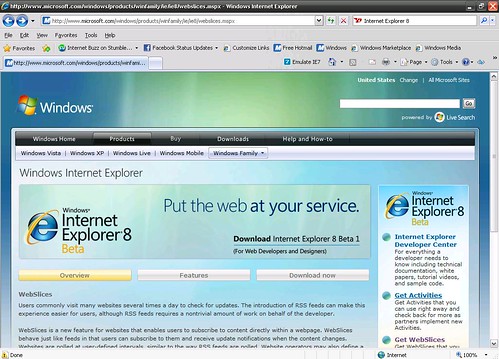
In the last round, security issues took centre-stage and underdog Firefox scored big against Microsoft's Internet Explorer thanks to this.
This round, we're looking at kids who've grown up on the internet, are immersed in the new-fangled web 2.0 world and want, above anything, a powerful browser that puts all their favourite social networking tools at their fingertips.
Witness Flock, social web browser extraodinaire, whose key selling point is the built-in interfaces it has for social networks like Facebook, Flickr, Blogger, Twitter, MySpace etc. Undoubtedly, Flock should be the winner, right? Err... no, not in my opinion. My brief test of Flock quickly showed me how having too many features and too much integration can be problematic in itself - the direct result being a cluttered interface.
So when I heard of the Microsoft announcement, I thought to myself "it's probably time to check out what the folks at MS have up their collective sleeves." And off I went to download my copy of Internet Explorer 8 beta 1.
Thoughts on IE8
Internet Explorer 8 beta 1 comes with two shiny new toys that more tightly integrate Web 2.0 activities into the browser. The first of these, which I happen to like very much is Web Slices. Essentially, a Web Slice is like a graphically enhanced RSS feed, or a frequently updated portion of a page, cleverly coded, so you can preview that portion of that page without actually surfing to said page.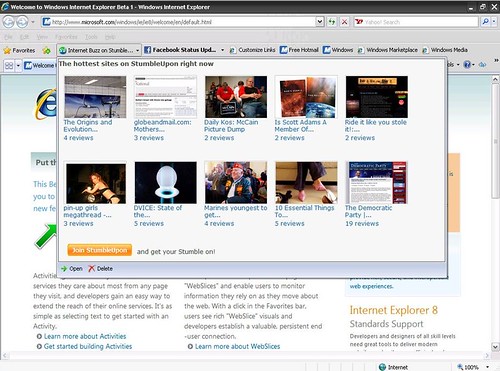
So, for example, the above picture shows a small 'slice' of the StumbleUpon homepage (the 'internet buzz' section) without having you to surf over to StumbleUpon to check out what has recently been 'stumbled'. Quite intuitive. You could also cut a 'slice' of your Facebook homepage and have it update you on your friends' latest updates.
The second key feature is what Microsoft calls Activities. What it really means is "stuff you can do from the right click menu." Okay, so actually this feature isn't really new and you can already do many things off a right-click with the appropriate plugins in FireFox and / or Flock. And to be honest, most of the couple of Activites in Microsoft's current line-up are just boring stuff tied to their services which no one uses (Blog on Spaces anyone?) There are useful ones, like "Share link via Facebook", which lets you instantly share the page you're on by posting it up on your Facebook page.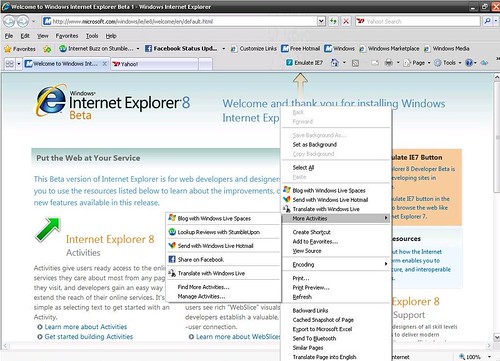
But still, I applaud the inclusion of functionality like Activities into Internet Explorer 8 simply because it validates the shifting of the web towards iteration 2.0. It validates what all of Microsoft's competitors have been doing. Who are we kidding? Internet Explorer will probably still be the web browser the majority of people will use because it's the one they find installed on their PCs. And by integrating Web 2.0 functionality into IE8, soon web-behaviour will shift towards the Web 2.0 dream the geeks and geekettes have been having.
Future of the browser
It's clear that the new frontier for war on the browser front will be waged on how well web-browsers can integrate Web 2.0 functionality. Each combatant manages this differently. Firefox gives you very base functionality, but has a fantastic plug-in system that let's you customise almost indefiitely. IE8's slices and activities show's some innovative thinking from the software giant. Flock tells me too much of a good thing can be bad.
What people will soon have to consider though is how much more heavy these browsers will be thanks to this new functionalities. I've heard horror stories of FireFox 3, and even the latest release candidate 2 is considered bloatware by many. To the uninitiated, this simply means that your computer slows down every time you open up an internet browser. The more it slows down, the "heavier" your browser is.
Secondly, most of these "social" browsers will collect private and personal information about you and insist that it's stored on your computer. Of course, you have the option of keying in all the passwords to your GMail, Twitter, Facebook, MySpace, Blogger, Del.icio.us, StumbleUpon, MSNLive, and Yahoo! accounts again if you like. But I suspect not very many people would. The danger in this is obvious, as we pander for the convenience having a socially-integrated web browser brings, we put ourselves at the risk of having much of our security information stolen. Sure, it's already happening now with saved passwords and cookies, but imagine a single browser piecing together your multiple identities on the web and then having all that data stolen? Even more dangerous, how about passing your laptop to a colleague to use and when he / she pops open the browser, he / she gets greeted by some very private Facebook messages?
Thirdly, with the rise of mobile devices, more and more emphasis will be placed on the "content" of the site and not the webpage itself. Sure, the browser will be relevant for a long time coming, but what about those mobile devices that basically let you browse what you want on the web without having to actually browse? For example, my client Nokia, has been developing some pretty cool S60 apps like Share Online which allows you to check out and comment on your own or your contacts Flickr photos without actually logging onto Flickr through a browser. Or Twibble, which I use as my main means of staying connected to Twitter without actually browsing over to Twitter. In fact, a lot of the integration of Web 2.0 functionality straight into the browser actually helps you get around actually "browsing" the page.
Just some thoughts to think about as we move into the next wave of Internetting. :)
Thursday, June 5, 2008
Rising petrol price, everything else to scale?
If you're looking for a real, solid commentary on yesterday's announcements, click here.
If you'd just like to read my wild speculation and often, unreferenced common wisdom thoughts, then continue reading:
I'm actually happy about the price increase. Not because it won't hurt my pocket (it will), but because I think the rolling back of subsidies will eventually allow Malaysians to up our standards of living to be on-par with developed countries.
What do I mean by this?
For a long time, Malaysia has been cited as one of the countries that has a 'low cost of living.' This is artificially so because of all the subsidies we have been getting. Cheap petrol, cheap chicken, cheap sugar, cheap electricity, cheap water, the list goes on. The 'low cost of living' has made it very lucrative for companies to invest into Malaysia because wages are kept low and the cost of doing business is lowered.
Of course, to the middle class folk, you'll realise that when it comes down to consumer goods, we pay just as much as any other country. How much does an iPod cost in Malaysia? Just as much as it costs in the US and in Singapore. This means that while we survive comfortably thanks to government controls and subsidies on essential items, consumer goods are still costly for us.
The rolling back of subsidies gradually will also mean that the cost of controlled items can no longer be maintained, and they must surely rise too. Chicken might cost more, rice certainly has and we're not even talking about raw materials and power here. The next thing that must surely happen is that wages too must increase, and this means services will cost more too.
What happens?
Take an average fresh grad earning RM 1,800 (yes, still!). Currently, he pays Rm 400 for his rent, RM 350 for public transport and RM 500 for food on a monthly basis. This means he only has RM 550 left of disposable income. He can't buy a car, and to buy consumer goods like an iPod means he's got to save for 3 - 4 months to afford that new gadget.
If, with the rolling back of subsidies, we see wages increasing about 30%, then the fresh graduate now would earn about RM 2,400. Rent goes up to RM 500, Transportation increases 40% to RM 490 and food to RM 600 monthly. His disposable income would have increased to RM 810 and this means his spending power now is much higher because consumer goods don't scale with the rolling back with subsidies (unless taxes are imposed).
Of course, I'm no economist and this thinking is probably very, very flawed in ways I can't spot. Still, it was worth a thought.
Wednesday, June 4, 2008
Back from camp
The back ache has finally struck - the after-effects of Camp Transformation 2008.
You see, we had this interesting game where we pushed people beyond their limits by making them do a modified deathcrawl (clip below from the movie 'Facing the Giants') for an hour and a half. I don't have pictures of what we actually did, but I was one of the guys below and boy, does my back ache now.
Still, this was an opportunity not to let go of, because simply, the game is not so much physical as it is mental. One brother told me after the game: "I wanted to give up and just walk away because it was so painful. But then I looked at the person next to me and he looked to be in more pain than me, and if I gave up I would let the entire team down." Then he wept. There are few things better for building brotherhood.
On a lighter note, I have to be thankful for Yow Looi and Adam's kind advice and counsel throughout the camp. Many, many times difficult decisions had to be made and without their solid perspectives, we might have made the wrong ones.
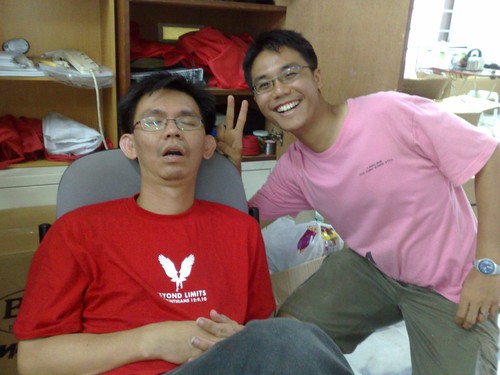
If I thought I was tired, you should have seen Yow Looi right after the camp: